Best 3D Rendering Software in 2026, Compared
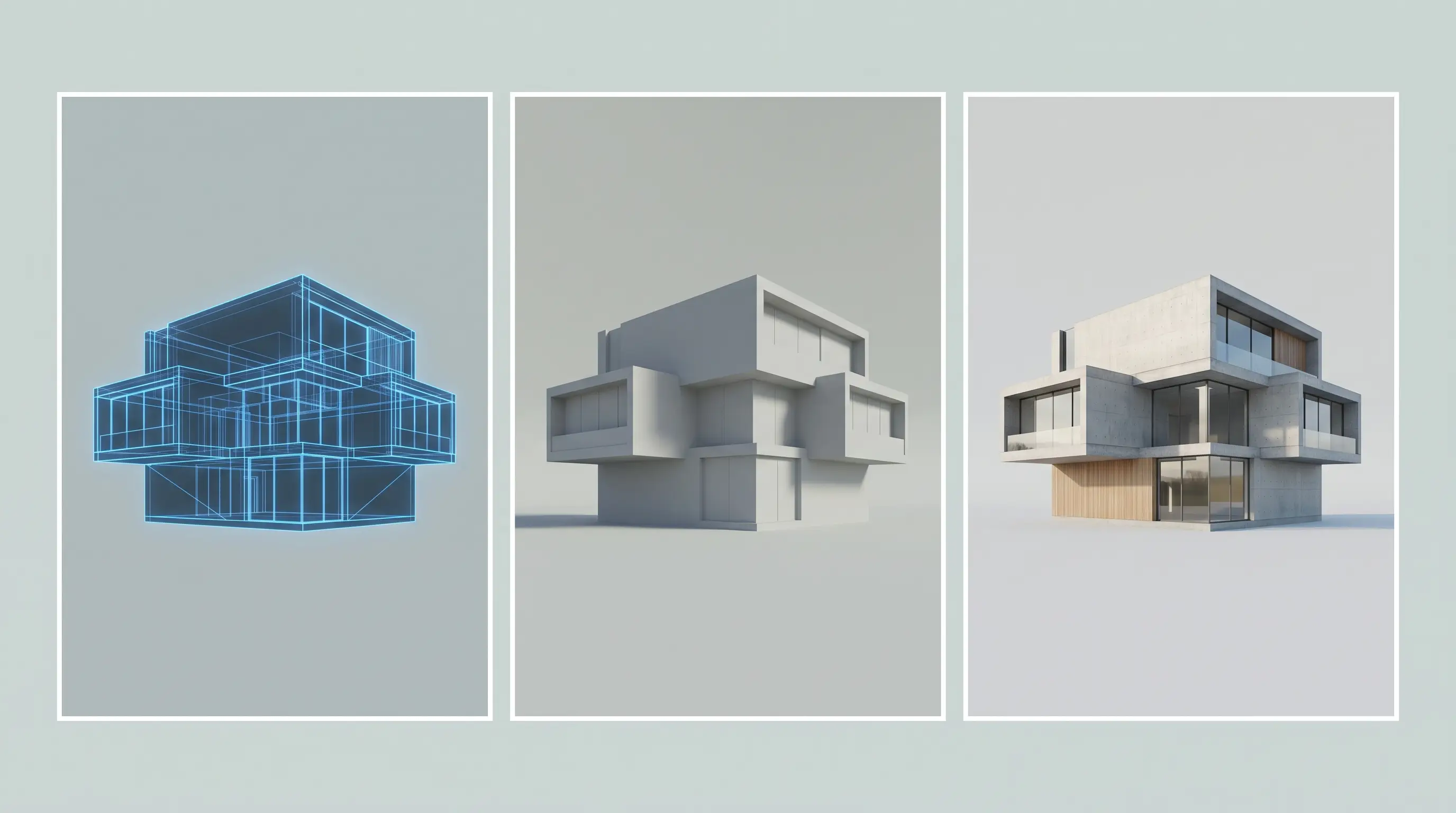
Choosing 3D rendering software is really choosing a workflow. The best 3D rendering software for architecture depends on whether you want real-time speed for client iteration, ray-traced polish for the final board, or tight integration with the BIM model you already build in. Below we compare the five tools architects ask about most in 2026. Or skip the software altogether, our architectural rendering service produces the same output without the learning curve.
Real-time vs offline rendering: the core choice
Every rendering tool sits on a spectrum. Real-time engines (Enscape, Twinmotion, D5 Render) render the scene live as you move the camera, brilliant for design iteration and client walkthroughs. Offline ray tracers (V-Ray, and Lumion's high-quality mode) take longer per image but push photorealism further. Most firms end up using one of each: a real-time tool for daily work and an offline renderer for the hero shot.
Enscape, best for live iteration inside your BIM model
Enscape is the most popular real-time renderer among architects because it lives inside Revit, SketchUp, Rhino, and ArchiCAD as a plugin, you never export a file. Change the model and the render updates instantly, which makes it ideal for firms that iterate constantly and want to walk clients through a design in real time. Quality is very good rather than the absolute best on this list, and the tight BIM integration is the whole point.
- Best for: architects who want live rendering without leaving their modelling app
- Strength: instant round-trip with Revit / SketchUp / Rhino / ArchiCAD
- Trade-off: less physically precise than a dedicated offline ray tracer
Lumion, the fastest path to a beautiful result
Lumion is built for speed-to-beauty. Its enormous library of materials, plants, people, and atmospheric skies lets you turn a plain model into an evocative scene in minutes. It's less physically accurate than V-Ray, but for marketing imagery, where mood matters more than millimetre precision, it's hugely productive. The learning curve is gentle and the results are consistently attractive, which is why it's a favourite for developer sales renders.
Twinmotion, the best value real-time renderer
Built on Unreal Engine, Twinmotion delivers real-time quality with an approachable interface and a generous asset library, at a price point well below the market. It's an excellent first real-time tool and a strong choice for small practices that want good walkthroughs and stills without a big software budget. Because it shares Unreal's pipeline, it also scales into interactive presentations and VR.
D5 Render, real-time ray tracing on a budget
D5 Render has won a lot of fans fast by pairing genuine real-time ray tracing with a low price and a gentle learning curve. Its lighting and reflections look noticeably more physical than older real-time engines, and its asset library keeps growing. For a solo architect or a small studio wanting near-photoreal stills quickly, D5 is often the best value in 2026.
V-Ray, the photoreal reference standard
When the final image has to be flawless, the competition cover, the printed brochure, offline ray tracers still set the bar, and V-Ray is the industry reference for accuracy and control. It plugs into 3ds Max, SketchUp, Rhino, and Revit, and gives you physically correct lighting and materials down to fine detail. The cost is the steepest learning curve on this list; V-Ray rewards expertise more than any other tool here.
3D rendering software compared at a glance
| Software | Type | Learning curve | Best for |
|---|---|---|---|
| Enscape | Real-time plugin | Low | Live iteration in BIM |
| Lumion | Hybrid | Low–Medium | Fast, beautiful marketing shots |
| Twinmotion | Real-time | Low | Value real-time + VR |
| D5 Render | Real-time RT | Low | Near-photoreal on a budget |
| V-Ray | Offline ray tracer | High | Uncompromising photorealism |
The best 3D rendering software for architecture, by use case
- Iterating live with clients → Enscape or D5 Render
- Prettiest result for the least effort → Lumion
- Best quality-per-dollar for a small studio → D5 Render or Twinmotion
- Uncompromising photoreal control, time to learn it → V-Ray
When to hire a studio instead of buying software
Every tool here takes weeks to learn well and months to master, that's the hidden cost. For a firm rendering daily, the investment pays off. For a practice that needs a handful of competition-grade images a few times a year, the maths usually favours hiring a studio that already owns the tools and the expertise. Our architectural rendering service covers exactly that case: the finished images, without the software licences or the months of learning.
Related service
Our architectural rendering serviceSmart 3D Render Studio
Photoreal 3D rendering for architects, developers and brands. About us.